
Before You Plan Your Home Extension, Read This
The decision that costs Glasgow homeowners thousands — and how to avoid it
There is a moment that happens in almost every home extension project in Glasgow.
You have the architect’s and structural engineer’s drawings. You have your planning permission approved. You are now going for the Building Warrant. You get excited — the idea you have been thinking about for years is actually starting to come to life, to materialise. You get impatient. And then it happens.
Oh, let’s just start getting ideas for a kitchen.
STOP THERE. DON’T DO IT!
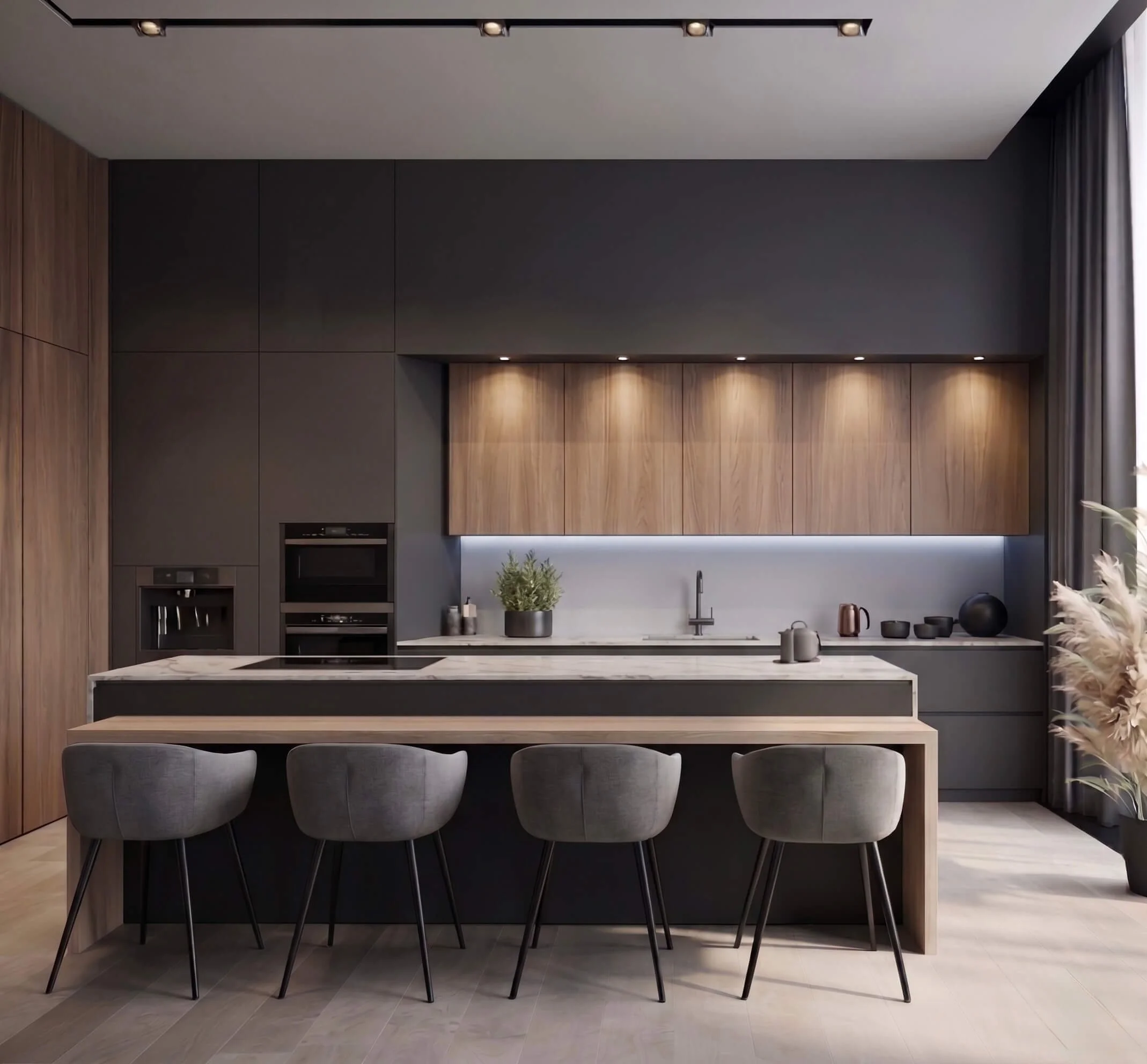
The kitchen your extension could become — designed around your actual space.
Resist the temptation of being pulled into a yes by a very convincing and enthusiastic kitchen designer looking for their next commission. Stop. Take a breath. And start looking for a design-and-build company instead.
Don’t get sidetracked by the shiny new island or the boiling water tap. Stay focused. Research your design-and-build company first.
Because visiting that showroom too early is one of the most expensive mistakes you can make.
Why Buying a Kitchen Before You Have a Design Is a Serious Problem
We have been designing and renovating homes across Glasgow for 37 years. In that time, we have seen the same scenario play out more times than we care to count. A homeowner falls in love with a kitchen in a showroom. They buy it. And then one of the following happens:
The kitchen arrives three weeks before the build is ready. It sits in the garage. It gets damaged. Doors warp. Units get scratched. By the time it’s ready to be fitted, it is no longer in the condition it was purchased in.
A deposit is paid, and then the builder refuses to fit it. Many builders build the shell and leave. Fitting a kitchen is simply not part of their remit. The homeowner is left with a kitchen they have financially committed to, and no one to install it.
The American fridge freezer won’t fit through the door. Not the showroom door — the door of your actual home. The one that was always going to be that width. The one that a site survey would have identified immediately.
The standard height flat-pack units look completely lost. Many of the properties we work in across Bearsden, Milngavie, Jordanhill, Lenzie, Bishopbriggs and the West End are Victorian and Edwardian homes with ceiling heights of 3.3 metres and above. A standard 2150mm kitchen unit in a room like that doesn’t look considered — it looks like an afterthought.
The entire budget is spent before a builder has even been found. The kitchen is ordered, deposited, and committed to — and then the build quotes come in higher than expected. Now there is no flexibility. No contingency. No room to make the right decisions.
The colour is completely wrong in the real space. A kitchen that looked stunning under showroom lighting looks entirely different once natural daylight pours through new bifold doors. The undertones shift. The finish changes. What felt perfect in the showroom feels wrong in the home.
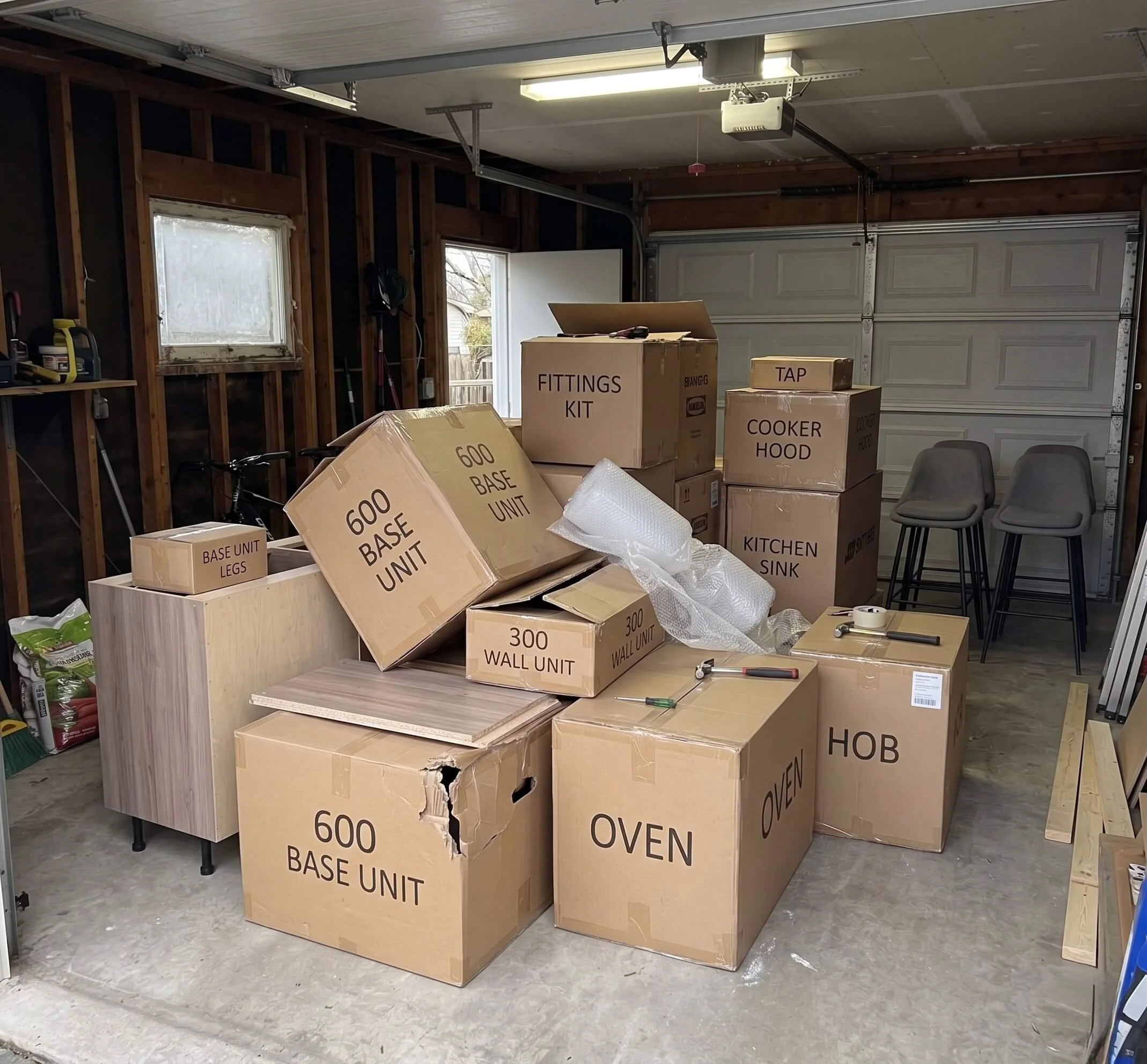
This is what happens when a kitchen is ordered before the build is ready. Boxes sitting in a garage — getting damaged, warping, scratching — weeks before a fitter is anywhere near the job.
You cannot order your kitchen until the space has been checked and measured
This is not an opinion. This is 37 years of experience speaking.
Drawings are perfectly fine for concepts and layouts. But you should never, under any circumstances, order a kitchen unless a kitchen fitter has physically checked and measured the space and will take full responsibility if something does not fit. If they won’t stand behind their measurements, do not place the order.
Natural daylight changes everything, too. The orientation of your extension — which direction it faces, where the doors and windows sit, how the light moves through the space across the day — determines which colours work, which finishes are flattering, and which materials will age well in that specific room.
No showroom can replicate that. No mood board can predict it. No sample tile under a fluorescent strip light will tell you how it looks at 4 pm on a January afternoon in the West End of Glasgow.
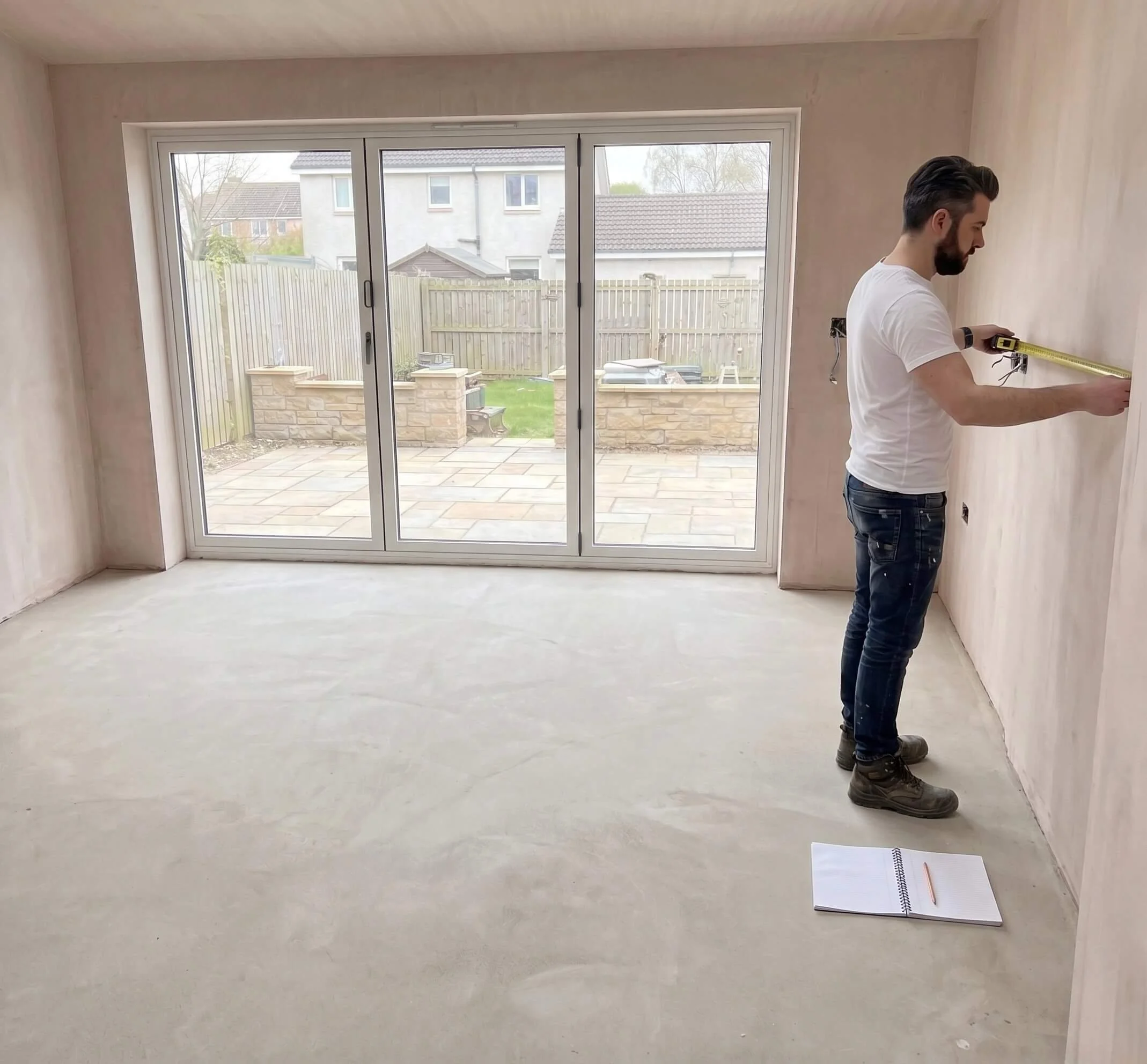
Every wall, every ceiling height, every opening — measured accurately in the real space before a single unit is ordered. This is where good design starts.
We will do the concept layout and finalise the exact dimensions required before we order anything for you. Designed, measured, and fitted by us. Our responsibility — not yours to worry about.
How to Choose the Right Design and Build Company — What Nobody Tells You
The second biggest mistake homeowners make — after buying the kitchen too early — is choosing the wrong team for the job. Here is what we would tell a close friend before they started:
Look at their previous work properly. Not the curated highlights on their website. Ask for case studies. Ask for testimonials. Read their Google reviews — not just the star rating, but what people actually say.
Ask if you can speak to a previous client. Any company worth its reputation will offer this without hesitation. Speaking to someone who has been through a project with them is worth more than any brochure.
Ask who manages the trades. A builder builds. But who coordinates the joiner, the electrician, the plumber, the tiler, the plasterer? Who makes sure the kitchen arrives when the kitchen fitter is ready? Who is your single point of contact when something needs a decision?
Notice how they show up. Are they on time? Are they organised? Do they arrive with a notepad and a tape measure, or do they arrive and tell you what you want to hear? Do they ask questions about how you live, how you cook, how your family uses the space — or do they talk only about what they can build?
Ask whether they offer a full design-and-build service. There is a significant difference between a builder who can also fit a kitchen and a company that designs the space first, takes accurate site measurements, produces CAD drawings, sources every product, coordinates every delivery, and manages every trade through to completion.
What Planning a Home Extension Properly Actually Looks Like
Before a single brick is laid, a properly planned extension project should include:
A full site survey with all trades present. That means the ground workers, builder, joiner, plumber, Gas Safe engineer, electrician, plasterer, decorator, and tiler, if required — all on site together, all seeing the job with their own eyes. No trade should go in blind. This is where the extras come from — the “we didn’t include for that” moment — because nobody saw the job properly, nobody knew your boiler was too old, and nobody checked whether your consumer unit had the capacity for a new extension. A joint site survey eliminates that. Every trade quotes on what they actually see, not what they assume.
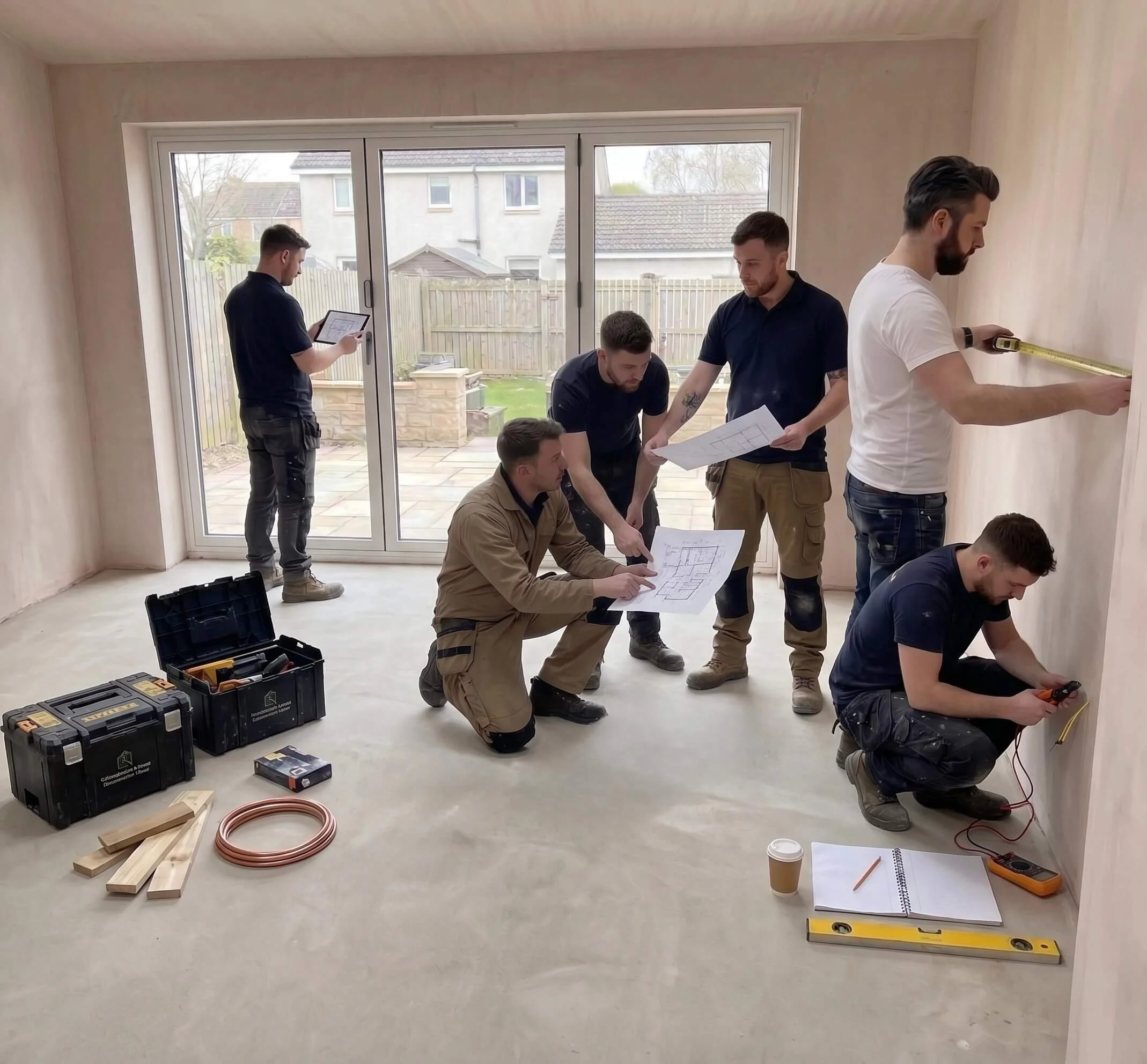
Every trade, on site together, seeing the job with their own eyes before pricing it. No assumptions. No surprises. No "we didn't include for that" halfway through your project.
A CAD design of the proposed space so you can see exactly what you are getting — not an approximation, but a precise drawing based on your actual home.
A 3D photorealistic render so you can visualise the finished space, the light, the materials, and the flow before committing to anything.
A realistic, transparent budget that covers not just the build, but the kitchen, bathroom, flooring, lighting, joinery, and every finish — so there are no nasty surprises halfway through.
A coordinated schedule so that every product arrives when the relevant tradesperson is ready.
This is not how every company works. But it is the only way we work.
Why This Matters Especially in Glasgow’s West End and Surrounding Areas
The properties across Bearsden, Milngavie, Lenzie, Bishopbriggs, Jordanhill, Hyndland, and the West End are not straightforward. Victorian and Edwardian homes have character, history, and proportions that require genuine expertise — not a catalogue solution.
Stone walls that don’t always behave. Deep cornicing that needs to be matched or carefully removed. Ceiling heights that demand bespoke joinery. Room proportions that no flat-pack kitchen was ever designed for.
Getting these homes right requires someone who has worked in them for decades. Someone who understands the planning sensitivities, the structural quirks, and the suppliers who can deliver the quality these spaces deserve.
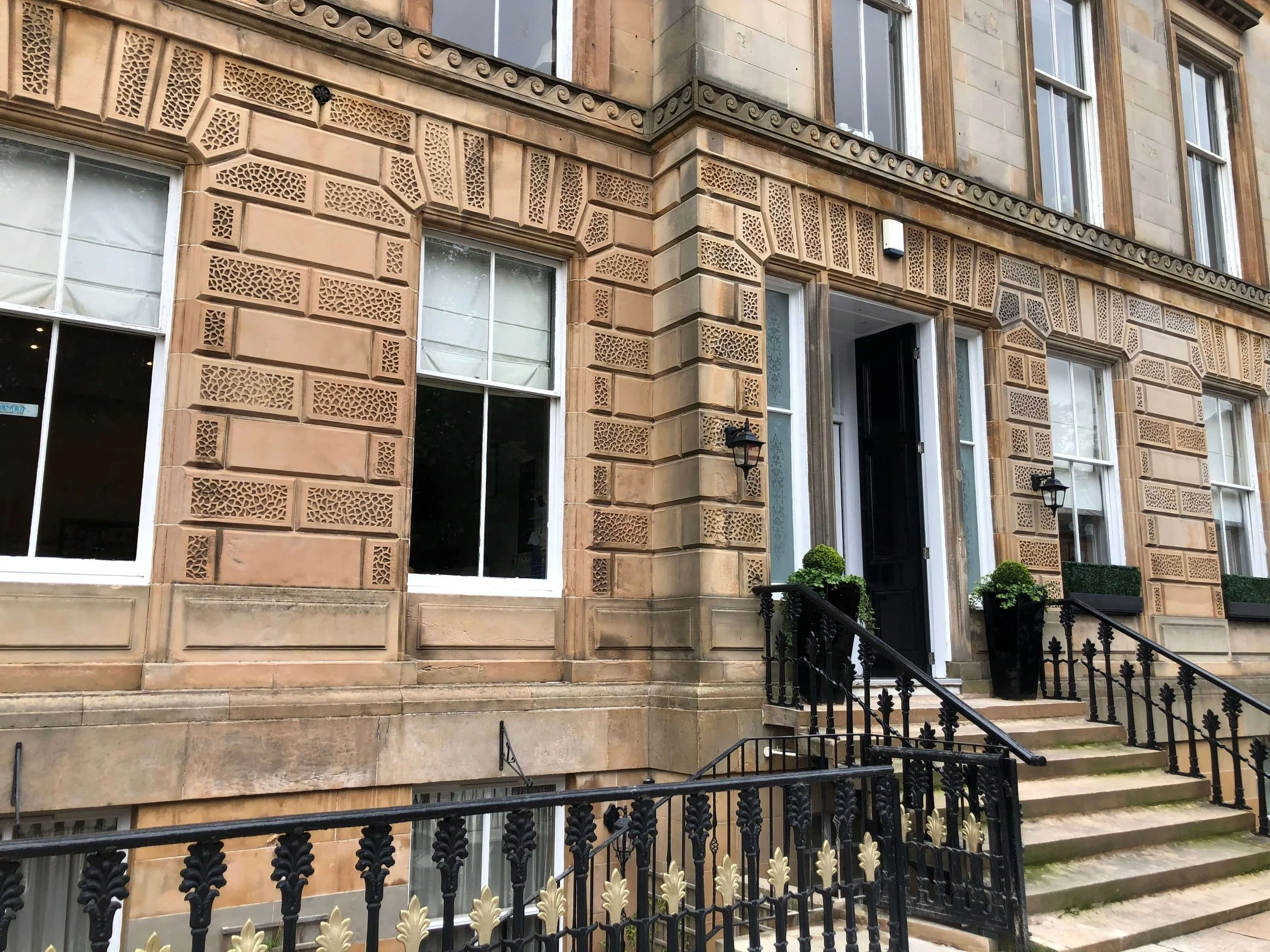
The Victorian and Edwardian properties across Glasgow's West End, Bearsden, Milngavie, Lenzie, Bishopbriggs and Jordanhill demand a level of expertise that no catalogue solution can deliver.
The Question to Ask Before You Do Anything Else
Before you visit a showroom, before you call a builder, before you pin anything else to a mood board — ask yourself this:
“Who is going to design the space, manage the project, coordinate the trades, and make sure my home looks exactly as I imagined it — on time and without the stress?”
If you don’t have a clear answer to that question, start here.
Interior Space Design has been designing and building homes across Glasgow for over 37 years. We are not the cheapest option. We are the option that means your project finishes on time, on budget, and exactly as you imagined it — with no stress, transparent and honest pricing, and genuine care for you and your family throughout.
Every project begins with a conversation. No obligation. No pressure.
If you are planning an extension in Bearsden, Milngavie, Jordanhill, Lenzie, Bishopbriggs, Hyndland, or the West End of Glasgow — let’s talk.
